22/11/09

THE PLACE

Long. 70º42' W / Lat. 30º08' S / Altitude 1478 m (4850 ft)


The Observatorio del Pangue stands atop a moderate hill in a mountainous landscape close to the Elqui Valley, located some 480 km (300 mi.) north to the capital city Santiago de Chile. The little town Vicuña is some 17 km (11 mi.) north to the observatory, while the regional cape town, La Serena, is some 80 km (43 mi.) westward.


The local view indeed is stunning, where the only human buildings visible in the far are the scientific observatories of SOAR, Gemini, and Tololo, all located within 11 km (7 mi.) to us. Yet the most noticeable feature of the region is the quality of the sky, resulting from a rare association of an adjusted geology, a favourable local climate, and a total absence of light pollution. Hence, these mountains have been selected among 5 candidate places in the world for installing the 500-million dollar budget facility, the next LSST, also 11 km (7 mi.) away from us.

At the Observatorio del Pangue you will indeed experience the unforgettable feeling of sharing the sky with the giants...


A stunning starry sky awaits you every night


The original summit has been flattened, prior to building the observatory... (click to enlarge)


360º panoramic view from the Observatorio del Pangue: the video starts due South West, facing the SOAR and Gemini observatories. The Tololo observatory, due West, comes into view a few seconds later.


The local zone, viewed from space (click to enlarge) - credit: NASA


Interactive map from GoogleMaps: you can easily find us by playing with the zoom digits and orientation arrows.

See also the Observatorio del Pangue (OdP) on the GoogleMaps page

THE TELESCOPES

Our telescopes are equipped with premium eyepieces and accessories, carefully selected, allowing an optimal, effortless sight to any target.

T400: Computarized Schmidt Cassegrain reflector MEADE LX200ACF,
aperture 16" (40cm), focal ratio f/10.

Origine: USA - imported february, 2008


Our scope poses proudly in front of the Cerro Tololo Observatory (that "little" dome silhouetted in the far horizon...)

T630: Dobson type reflector OBSESSION, aperture 25" (63cm), focal ratio f/5.
Origine: USA - imported september, 2008

Currently the largest public telescope in Chile...


T300: Dobson type reflector ORION SkyQuest, aperture 12" (30cm), focal ratio f/4.9
Origine: China - imported september 2007

Available for the amateur astronomers, who'll certainly enjoy the opportunity to push this otherwise excellent scope beyond its expected limits...


The T400, viewing Jupiter, the Moon, and almost aligned the Cerro Tololo Observatory (the little black dome silhouetted in the horizon...)


The T630, next to its rolling roof, ready for one more of the deep sky observing sessions.


TARIFS - BOOKING - HOW TO FIND US

All given prices are applicable currently, and subject to further variations
How to use it: introduce an amount in any of the three currencies, and it will automatically display in the other two.

TOUR ASTRO: Cl$ 16,000 per person
The transfert to the observatory is included in the price.

It is recommended to book in advance. Reservations by phone or by internet will be maintained untill the payment is fully cancelled. All payments must be cancelled not later than 16H00 (4:00 p.m.) the day of the Tour, otherwise the reservation is annuled.

We accept US dollars and euros with a light surcharge, that makes 35 US dollars and 25 euros respectively (subject to variations).

In case of annulation of the Tour for adverse weather conditions, we'll refund 100% of the amount paid.

TOUR ASTRO PRIVATE: Cl$ 125.000 per group
The transfert to the observatory is not included in the price.

This programme is intended for groups managed by national tour operators, or disposing of their own vehicles, who like the benefits of an exclusive service.

Similar to the Tour Astro, except for the limiting number of participants, extended to 14 people.

TOUR EXTREME: Cl$ 144,000 per group
The transfert to the observatory is not included in the price, although it remains available upon request at additional cost.

The tariffs are per group, not depending on the number of participants, although we recommend not exceed 15 people.
Due to logistics requirements, groups over 20 people must split in two sub groups, performing the programme in two successive runs.
In such a case, the tariff is CL$240.000 for the whole group.

If some of the participants are certified members of an astronomy organisation, a 15% discount is applicable to the whole group.

Upon reservation only, with a minimum anticipation of 2 days.

We request process the payment in that same delay, via bank transfert (ask for conditions). In some particular cases, we do accept payment cash at our agency, not later than 14H00 (2:00 p.m.) in the day of the Tour. Reservations not cancelled in the given delays will be annuled. We accept US dollars and euros (ask for conditions).

In case of annulation of the Tour for adverse weather conditions, we'll refund 100% of the amount paid.

NIGHT EXTREME: Cl$ 280.000 per group
The given price does not include transportation to the observatory, as this programme is intended for groups managed by national tour operators, or disposing of their own vehicles.

The tariffs are per group, not depending on the number of participants, although we recommend not exceed 15 people. If some of the participants are certified members of an astronomy organisation, a 15% discount is applicable to the whole group.

Upon reservation only, with a minimum anticipation of 7 days.

Payments must be processed in that delay, through bank transfert (ask for conditions), otherwise the reservation is annuled.

In case of annulation of the Tour for adverse weather conditions, we'll refund 100% of the amount paid.

JOURNEY EXTREME: For those groups who wish to observe for more than one night, we designed a saving tariff, as following:
2 consecutive nights: Cl$ 532.000
3 consecutive nights: Cl$ 756.000
4 consecutive nights: Cl$ 952.000
5 consecutive nights: Cl$ 1.120.000

Similar to the previous one in terms and contents, except for the reservation delay that comes to 15 days.


HOW TO FIND US... AND WHEN

Remember that the spectacle of the celestial sphere is significantly disminuished in presence of strong moonlight so, when planning a stargazing, it is highly recommended to avoid the nights with Full Moon or near Full Moon phases. In order to help you in preparing your observing session, we give a moon phase calendar (click here). Hence the Observatory remains closed on the next following moonlight nights:

march, 2 to 9
april, 2 to 7
may, 2 to 6
june: closed all month

Additionally, we give the periods of visibility for the main planets (click on the table at left to enlarge).


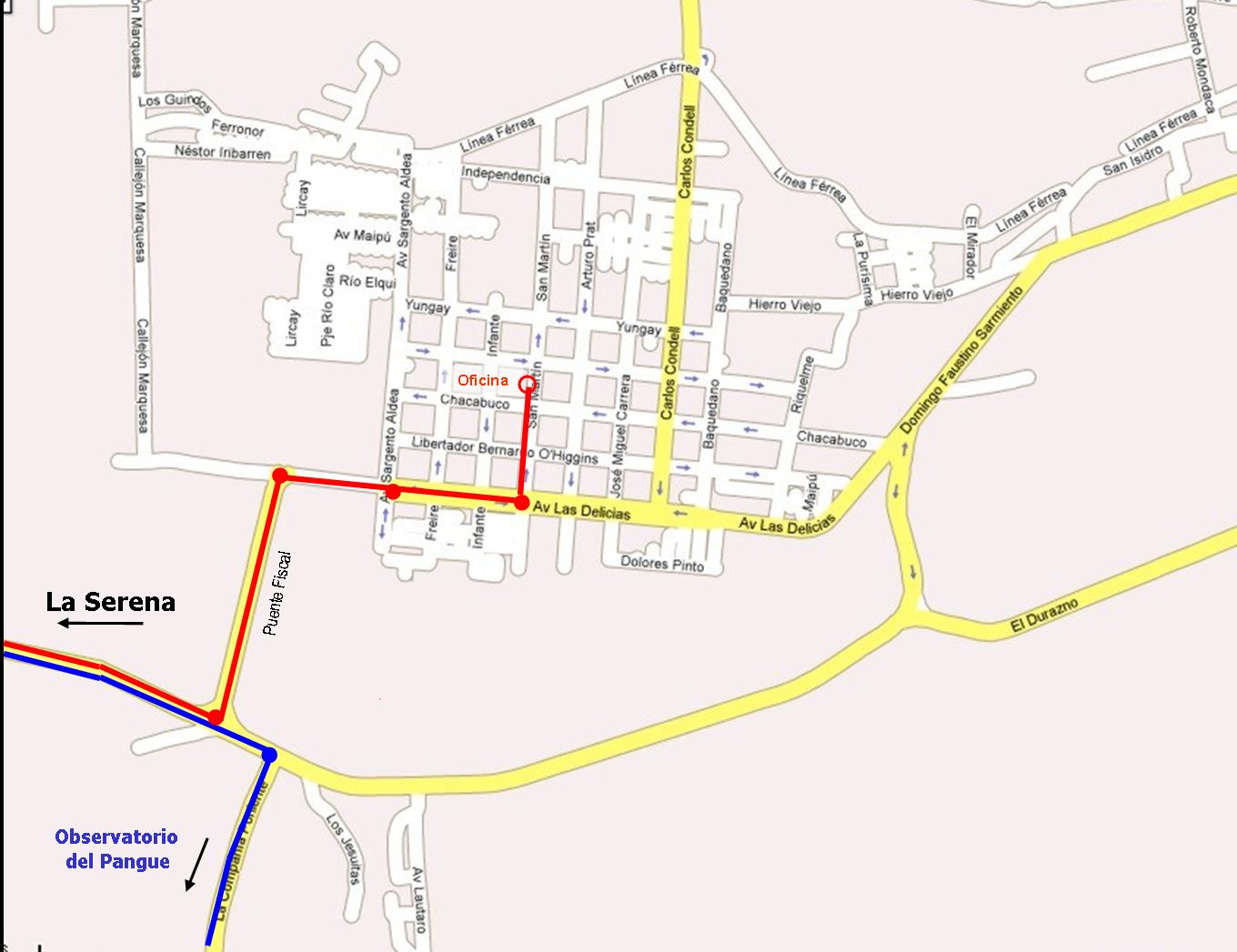
Then, as to find us, we give below a short description of the road from Santiago to the Observatory, although you may prefer to visualize it by using an interactive map (click here).

Santiago - La Serena: 480 km (300 mi.)
Air travelling is convenient since there are several flights connecting each day the international airport of Santiago to the airport of La Serena. Surface travelling also is easy, as the "Ruta 5 Norte" is a fast riding highway. Many bus companies reach la Serena every day (the journey lasts some 7 to 8 hours).

La Serena - Vicuña: 63 km (39 mi.)
The "Ruta 41" road is the only choice to reach Vicuña. To get there, you can choose either a bus from the many local companies, or a "colectivo" (collective taxicab). Note however that there is no such public transportation back to La Serena by night. Our office is located in the Plaza de Armas of Vicuña (address San Martin 233), quite close to the "Torre Bauer", the local icon.

NEW:
A Shuttle from the Airport of La Serena to Vicuña is available as a service of the Observatory. The cost is CL$50.000 for the group (up to 8 people). Service includes:
- Transfert from the airport to your hotel in Vicuña at your arrival;
- Transfert from your hotel in Vicuña to the airport for your departure;
Times and dates are scheduled according to your flights.
Upon reservation only, with a minimum anticipation of 2 days.

Vicuña - Observatorio del Pangue: 17 km (10 mi.)
The transfert from Vicuña to the observatory with our van is included in most of our programmes. However, if you have to go with your own vehicle, you may leave Vicuña through its southern exit, then reach a few meters ahead the intersection with the "Ruta D445", labelled as “Ruta Antakari”, leading south eventually to the town Hurtado. The entrance of the observatory stands exactly 16 km (10 mi.) from this intersection. The road is suitable for any vehicle (AWD is not necessary), although some steep curves in the last 2 kilometers may require a little care. The transfert at low speed lasts some 25 minutes (30 minutes if coming from the centre of Vicuña).

Furthermore, for any query you may have, don't hesitate to ask us at astronomicasur@gmail.com


FOR BOOKING NOW, CLICK HERE
THE PROGRAMMES


photo: Cristian Valenzuela / Observatorio del Pangue

We propose a series of services, ranging from the traditional 2-hours guided tour, to the loan of the full observatory for complete nights. Here we display the most popular services: for our additional proposals, or for any alternative service you could wish, don't hesitate to ask us.

TOUR ASTRO
Suitable for the general public, the Tour Astro allows our guests to discover the wonders of the Universe in optimal conditions. Not only you will observe through state-of-the-art telescopes, but you will deeply understand what you see, thanks to the clever, accurate, and always surprising explainations given by our personnel. Moreover, any query is welcome, and just every question will be answered, either about the latest astronomy news, or about leading astrophysics topics. Hence, without any previous knowledge in astronomy, you'll be allowed to truly enjoy the endless enchantment of the Universe to which we do belong.


The Tour Astro performs with a minimum of 5 people, and a strict maximum of 10 in order to preserve the personalized attention. The group is assisted by 2 astronomers. We are open all year, except the nights with excessive moonlight (see "Tarifs-Booking" page).

We admit children over 14 years old only.

The available languages are spanish, english, and french.

Unforgettable experiences are made of this: limited groups, friendly hosted by an astronomer, under a truly outstanding sky...

Photo: Miguel Carvajal

Contents:
1.
Departure from the agency in Vicuña, transfert to the Observatory aboard our minivan (about 30 minutes);
2. Welcome to the guests, sight of the stunning sunset landscape, with the great scientific observatories visible in the far (1st Tour only);
3. Unaided eye sight of the sky: constellations, Milky Way, Magellanic Clouds, etc...
4. Observing session through the T400 telescope (computarized, 16 inches of aperture). The programme includes all the wonders of the night, such as star clusters, nebulae, galaxies, not forgetting the Moon and planets as available, as well as any specific object you could wish to look at.
5. Hot drinks service in lounge, and return to Vicuña.

The programme lasts 2 hours on site (3 hours in total with the transferts from/to Vicuña), and may include some short audiovisual presentations.

Timetable:
The departing time obviously depends on the seasons: in winter (june-july) the first Tour starts at 18H00 (6:00 pm) local time, while in summer (december-january) it starts at 21H00 (9:00 pm) local time, with the corresponding extrapolated times for the rest of the year. The second Tour starts exactly 2 hours later than the first one. Upon demand, a third Tour can be performed, also starting 2 hours later than the previous one.

Current departure from Vicuña: 21H00 (9:00 pm)

TOUR EXTREME
Same as the Tour Astro in its contents and timetable, but with the T630 telescope (25 inches of aperture).


Due to its proper characteristics, this programme is mainly intended for experienced observers like amateur astronomers: apart for being manually operated, the telescope is really big, so the eyepiece may locate 3 meters above ground level, indeed not so practical for general public...

The "effort" is worth anyway, since you will discover the stunning deep sky objects such as exotic nebulae or distant galaxy clusters, or even observe the familiar objects but under conditions you never expected to meet.

The Tour Extreme is available for groups only, and lasts 3 hours on site (4 hours in total including transfert from/to Vicuña). Participants are allowed to use the T400 computarized telescope too.

photo: Miguel Carvajal


NIGHT EXTREME
Strictly intended for amateur astronomers, either individuals or groups (clubs and associations), either for visual observations or for performing astrophotogtaphy.

The observers dispose of the complete facility: telescopes, visual observing and astrophotography accessories, charts, computers, etc... You can follow our observing lists, or perform your own observing programme. In every case, you'll benefit of a permanent technical assistance, and a free access to the cafeteria.

The programme Extreme Night is not time-limited, except maybe by the dawn...

The starting time also is established at the convenience of the group.

Imagine yourself in such a place...


In case of booking several consecutive nights, a saving tariff is aplicable. Members of astronomy clubs and associations may also benefit of an additional discount.

THE STAFF

The "Observatorio del Pangue" has been originally planned by Astronomica del Sur Ltda. (ASL), a company specialized in the realization of astronomical projects and training of personnel, for both public and private organizations. Managed by Eduardo Valenzuela Palma, ASL was initially a successful company, having realized a series of astronomical facilities in Chile, such as the Observatorio Inca de Oro in 2007, right in the heart of the Atacama Desert, and the Explora Observatory in 2008, in San Pedro de Atacama, while preparing to develop its own facility, the Observatorio del Pangue. However, the administration of the original board practically led to the bankrupcy of ASL. Fortunately, the french astronomer Eric Escalera managed to save the infrastructures and equipments of the Observatory, that now runs successsfully as a proper entity. Indeed, the current Direction is allowed to fulfill its initial commitment: deliver a high quality service, that everyone can fully enjoy...


Director
Eric Escalera

Astronomer
Ph.D. in Astrophysics at the Université Paul Sabatier (Toulouse, France)


...somewhere in the Atacama Desert, Chile.


Principal Operator
Cristian Valenzuela Videla
Experienced amateur astronomer, astrophotographer


Magellan Telescopes, Las Campanas Observatory, Chile


Operator
Emilio Lepeley Sepulveda
Amateur astronomer


...feels comfortable on the asteroid-shaped exotic landscape of Chile (Comuna de Chañaral)